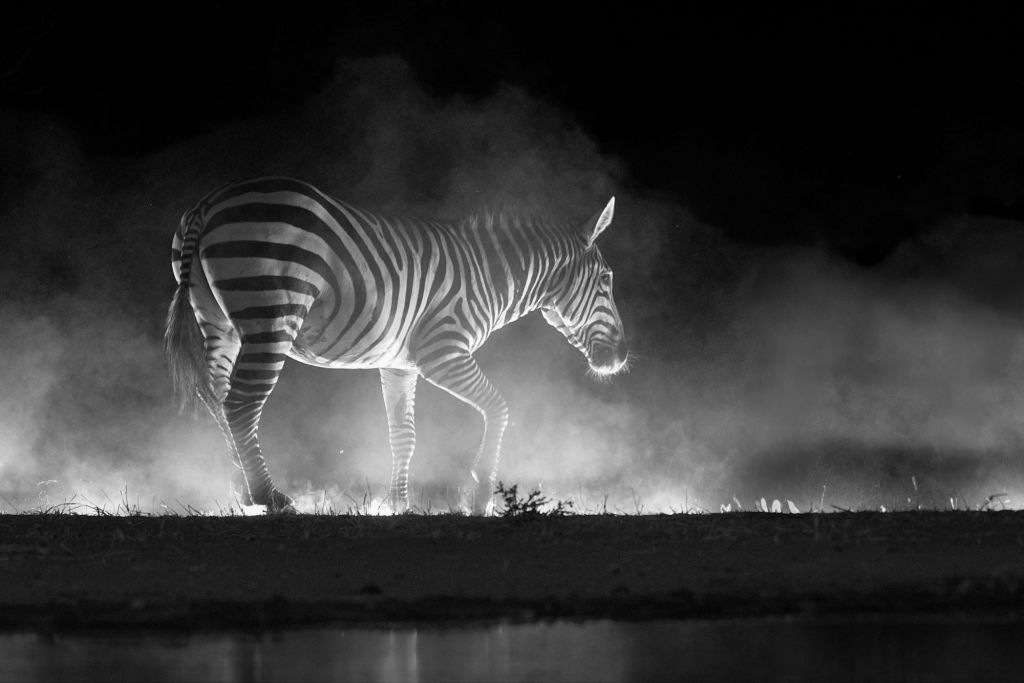
Emerging from the pitch-black darkness of the Southern Kenyan night, a zebra steps onto the edge of the waterhole at Shompole Wilderness. Positioned within a sunken hide—where the lens axis sits mere inches above the water level—the composition utilizes a low perspective to transform the immediate bank into a stark silhouette while capturing the dusts in the dark, and mirror-like reflections on the tranquil foreground water.
The visual drama is driven by strategic low-angle backlighting positioned directly behind the subject across the waterhole. This directional beam serves two critical technical functions: it creates a razor-sharp rim light that traces the zebra’s contours, ears, and spine—separating form from the deep black void—and it illuminates fine airborne dust stirred by movement, transforming suspended particles into a diffuse, atmospheric fog via volumetric scattering.
To capture this nocturnal sequence, the exposure strategy demands a delicate balance between light gathering and action freezing. A wide aperture around f/4 maximizes photon collection on the sensor while maintaining depth of field across the body. A shutter speed near 1/250sec freezes the animal’s stride and the motion of individual dust grains without motion blur. Combined with a elevated ISO sensitivity (~6400), the exposure metering prioritizes highlight preservation along the rim-lit edges, deliberately clipping non-illuminated areas into total shadow.
In post-processing, converting the image to high-contrast monochrome strips away distracting color cast from artificial light sources. Deepening the shadows drops background noise to pure black, while boosting localized contrast along the high-frequency stripe patterns amplifies the graphic, sculptured texture of the hide against the backlit haze.
#shompolenights #discovery #nationalgeographic #bbcearth #wildlifephotography #africansafari #bbcwildlifemagazine #Sony #animalplanet #zebra


Leave a Reply