There is a specific kind of silence that blankets the Terai ecosystem just after dawn. It isn’t the absence of sound, but rather a tense, living stillness.
On this particular morning at Dudhwa National Park, the air was thick with moisture, and the scent of damp earth and crushed vegetation hung heavy. Our gypsy crawled along the muddy tracks, navigating toward Bankey Taal, a massive, pristine wetland nestled deep within the reserve. Famous for its resident population of rare swamp deer (Barasingha) and its labyrinth of towering elephant grass, Bankey Taal is a legendary crucible of predator and prey.
The Moment of Realization:
We had stopped near the edge of the water body, watching the mist slowly lift from the surface of the taal. The reflections of the reeds danced perfectly on the glassy water. Then, the jungle gave itself away.
A sharp, frantic alarm call of a spotted deer cut through the air, followed by the deep, resonant bark of a langur from the canopy above. The message was clear: the apex predator was on the move.
We scanned the wall of vibrant green Saccharum grass. To the untrained eye, it looked impenetrable. But then, the grass parted.
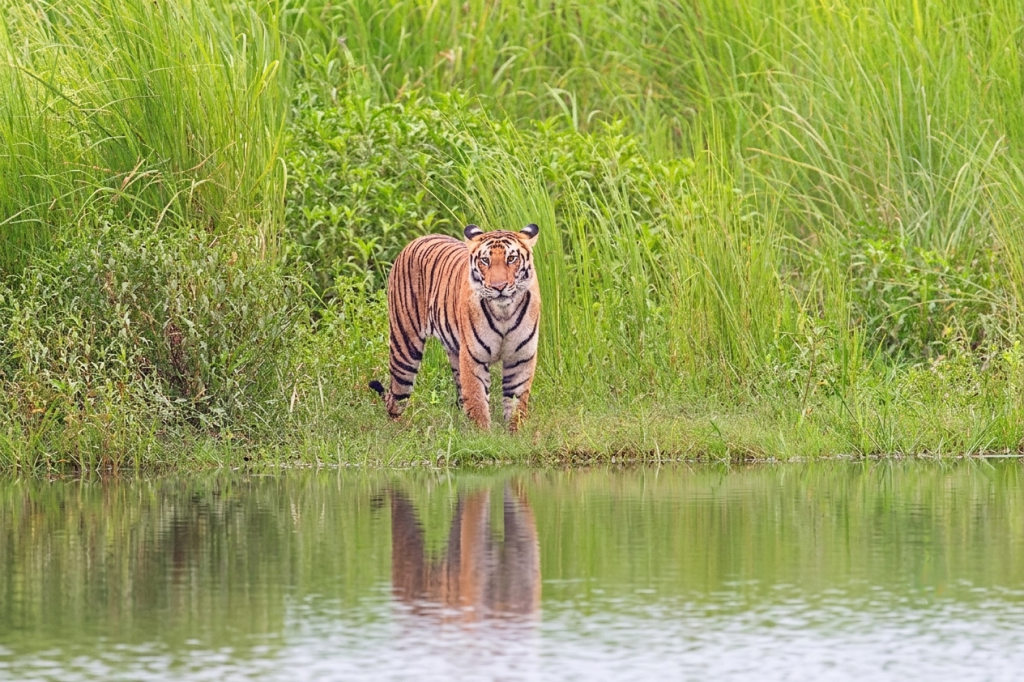
The Encounter: Orange Gold in a Sea of Green. Emerging from the dense undergrowth, a magnificent Bengal Tiger stepped into the open along the water’s edge.
Location: Bankey Taal, Dudhwa Tiger Reserve
Subject: Panthera tigris tigris (Bengal Tiger)
Habitat: Terai-Duar Savannah and grasslands
The contrast was nothing short of breathtaking. Tigers are often envisioned in the dry, deciduous forests of Central India, framed by rocks and yellow grass. But here in Dudhwa, they belong to a world of lush, almost electric green.
Notes from the Field:
The Camouflage: Seeing a tiger in this setting completely redefines your understanding of their stripes. As the tiger walked parallel to the tall grass, the vertical black markings perfectly mimicked the shadows cast by the individual blades of elephant grass. Even an animal that large can vanish in seconds.
The Stalking Gait: Notice the position of its tail—curled slightly upward at the tip, a sign of alertness and intent. The tiger moved with an effortless, fluid grace, its massive paws sinking silently into the soft, marshy earth near the water.
The Reflection: In the foreground, the calm water of Bankey Taal caught a shimmering, fractured reflection of its orange coat.
Understanding the Terai Ecosystem:
This image captures the very essence of why Dudhwa is so unique. The reserve is part of the **Terai-Duar savanna and grasslands eco-region**, a highly dynamic landscape characterized by:
1. Alluvial Grasslands: Towering elephant grass that provides perfect cover for tigers and rhinos.
2. Swamp Forests & Taals:
Perennial water bodies like Bankey Taal that act as critical watering holes and support a massive prey base.
For a few fleeting moments, the tiger paused, looking across the marsh—perhaps tracking a herd of Barasingha grazing on the distant banks or assessing the water before crossing. It didn’t spare a glance toward our vehicle; its focus was entirely locked onto the rhythms of its kingdom.
And just as silently as it had appeared, the tiger melted back into the emerald wall of the Terai, leaving behind nothing but a ripple on the water and a group of stunned onlookers.
Traveler’s Tip:When visiting Dudhwa, skip the rush to simply “spot” an animal. Spend time sitting quietly by the taals (lakes) like Bankey or Sonaripur. The Terai rewards patience, and more often than not, the magic comes to you.


Leave a Reply