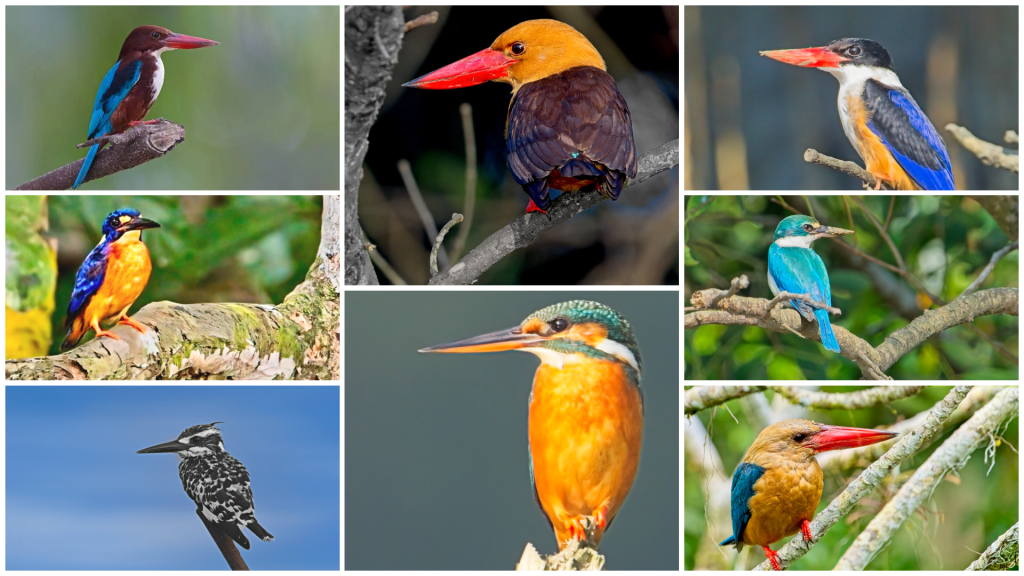
When most people think of Bhitarkanika National Park in Odisha, their minds go straight to the prehistoric giants—the massive saltwater crocodiles basking on the muddy banks. But if you look up from the water’s edge and focus on the low-hanging branches of the mangrove trees, you will discover the park’s true jewels.Bhitarkanika is widely considered India’s ultimate Kingfisher paradise. Out of the 12 kingfisher species found across the entire country, a staggering 8 species live right here in this single, unique mangrove ecosystem.For bird watchers and wildlife photographers, a slow boat safari through these tidal creeks is like floating through an open-air art gallery. Let’s break down the spectacular species you can spot here, starting with the absolute royalty of the swamp.
The Big Three: Mangrove Specialists. While some kingfishers can be found near any neighborhood pond, Bhitarkanika is famous for hosting rare, specialized species that rely completely on salt marshes and coastal mangroves.
1. The Brown-winged Kingfisher (Pelargopsis amauroptera)This is the ultimate prize for birders visiting Odisha. Outside of a few coastal pockets in Eastern India and Bangladesh, this bird is incredibly hard to find. It is a large, heavy-billed kingfisher with a gorgeous, almost neon-orange head and underparts, contrasted against dark chocolate-brown wings.
What to look for: Look closely at the image above. Notice that massive, dagger-like bright red bill. Unlike many other skittish kingfisher species, the Brown-winged Kingfisher is notoriously bold. If you approach quietly on a pole-driven boat, it will often sit perfectly still on a low branch, giving you full-frame photo opportunities.
2. The Black-capped Kingfisher (Halcyon pileata) If the Brown-winged is the most sought-after, the Black-capped Kingfisher is arguably the most striking. It sports a velvety black cap, a bright white collar, a rich purple-blue back, and a deep orange belly.
What to look for: As seen in the image, the contrast between its jet-black head and brilliant blue wings makes it a flash of pure color when it darts across the muddy channels. They love the deep, shaded interior of the mangrove creeks.
3. The Collared Kingfisher (Todiramphus sanctus) Strictly a coastal and mangrove resident, the Collared Kingfisher is smaller than the previous two but lacks nothing in beauty. It features a greenish-blue upper body and a clean, stark white collar and underbelly.
What to look for: Notice its distinctive white “collar” and the elegant turquoise hue of its back. These birds are highly territorial and can often be heard making a loud, harsh clicking call as they guard their favorite fishing perches.
The Other Five: The Supporting Cas.
tWhile the mangrove specialists take center stage, you are highly likely to cross paths with five other dazzling species during a two-day safari:
The Pied Kingfisher: A master of aerodynamics. Unlike others that hunt from a perch, the Pied Kingfisher hovers over open water like a tiny helicopter before diving straight down to grab its prey. Its monochrome black-and-white patterns are incredibly elegant.
AThe Stork-billed Kingfisher: A massive bird with a blue back, yellowish-brown underparts, and a colossal red beak. It is a formidable hunter capable of pulling surprisingly large fish out of the water.
The White-throated Kingfisher: The most common kingfisher in India, known for its brilliant electric-blue back and chocolate-brown chest. It actually hunts away from water quite often, catching lizards and large insects.
The Common Kingfisher: Small, fast, and metallic blue. It zip-lines just inches above the water surface like a glowing blue bullet.
The blue-eared Kingfishers: A secretive, blue colored beauty that is occasionally spotted deeper in the forest canopy during specific seasons.
Pro-Tips for a Bhitarkanika Birding Trip:
If you’re planning a trip to witness this avian spectacle, keep these essential tips in mind: The Low Tide Advantage: Always check the tide charts. Kingfishers are most active during low tide. As the water recedes, mudflats and low mangrove roots are exposed, trapping small crabs, mudskippers, and fish. This creates an absolute buffet for the birds and forces them down into clear view.
Hire a Dedicated Local Birding Guide: While any boatman can spot a 15-foot crocodile, you need an experienced local birding naturalist (like the well-known guides based out of the Khola or Dangamal gates) to spot the camouflaged kingfishers nestled deep within the leaves. They know exactly which creeks belong to which species. Biswajit and Bijoy Das are best of the lot.
Best Time to Visit: The park is open from November to May. The winter months (December to February) offer pleasant weather (15° to 28°C) and are perfect for catching both resident kingfishers and migratory birds.
Getting There: Bhitarkanika is roughly a 3.5 to 4-hour drive (around 150-160 km) from the capital city of Bhubaneswar, which is well-connected by air and rail.


Leave a Reply